
Last Updated:
What happens on the first visit
- Locating the failureIf a camera can reach the collapse, its distance is measured and a sonde is traced from the surface to mark the spot and approximate depth. If the camera cannot pass, the visit records how far it reached and treats everything beyond as unknown.
- What to have readyNote when drains stopped, which fixtures still drain, any sewage surfacing or sunken ground in the yard, and whether anyone has already cleared or jetted the line. Keep people and pets away from wet or settling ground near the route.
- What cannot be seen yetThe pipe past a collapse usually cannot be inspected until the blockage is removed. The full repair length, the condition downstream and the exact depth can change once the ground is opened, and the written scope should say so plainly.
- Written next stepsThe scope separates the immediate repair from any later work and states the method, excavation or access points, trench protection, permit and right-of-way needs, restoration responsibilities and the camera inspection of the repaired line.
A camera that cannot move forward has reached a limit. It has not, by itself, proved a collapsed sewer. Roots, deposits, a severe offset or another obstruction can stop an inspection too. The first task is to establish what has actually been seen and how much remains unknown beyond it.
Douglas Sewer Line Repair Seattle provides collapsed sewer line repair for private laterals, with work performed by fully licensed and insured contractors. When the pipe has lost continuity or its usable shape, the repair needs defined endpoints, suitable access and a method that can address that physical failure. The recommendation should explain those elements before it becomes a replacement total.
What a collapse means for the route
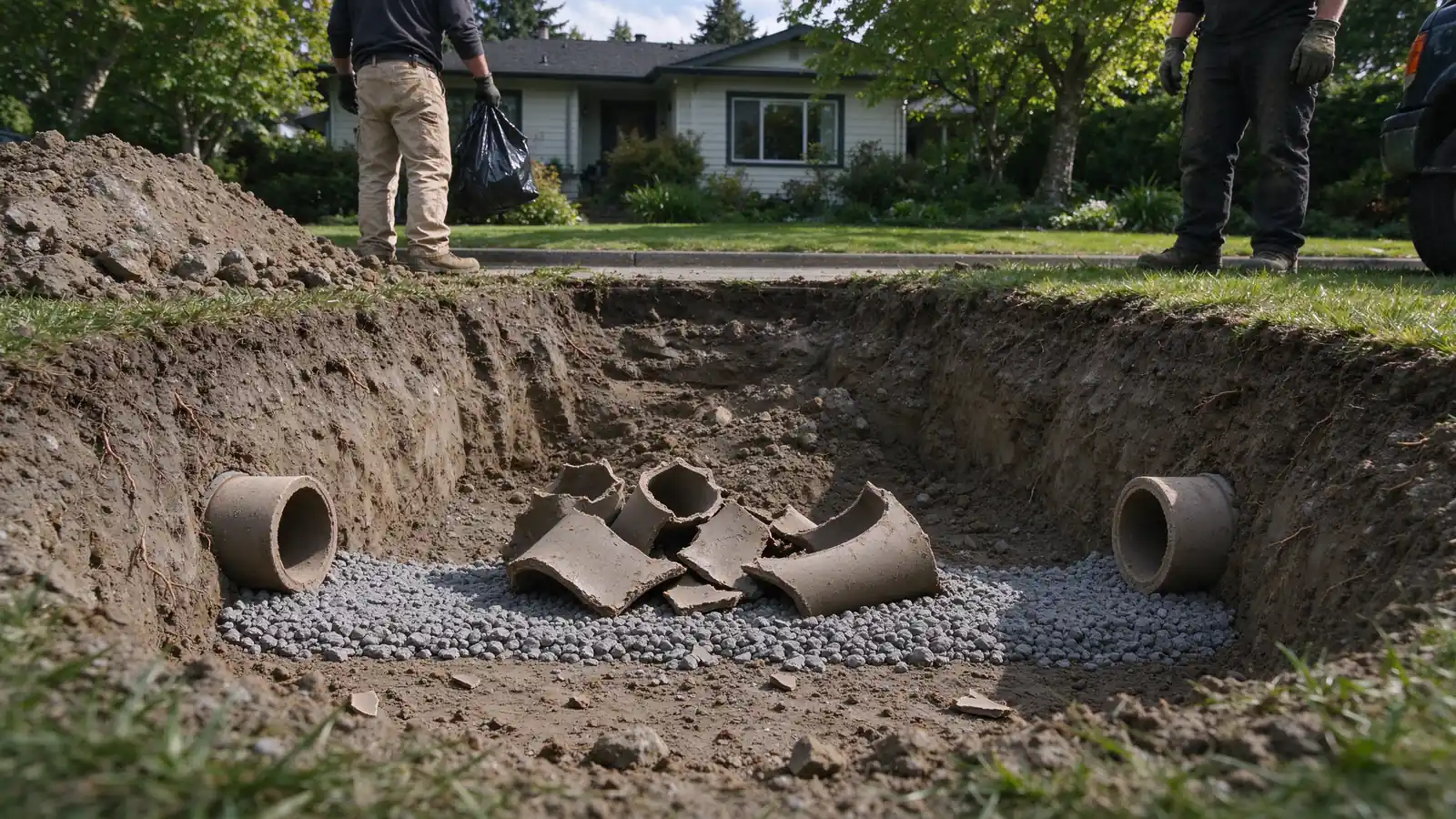
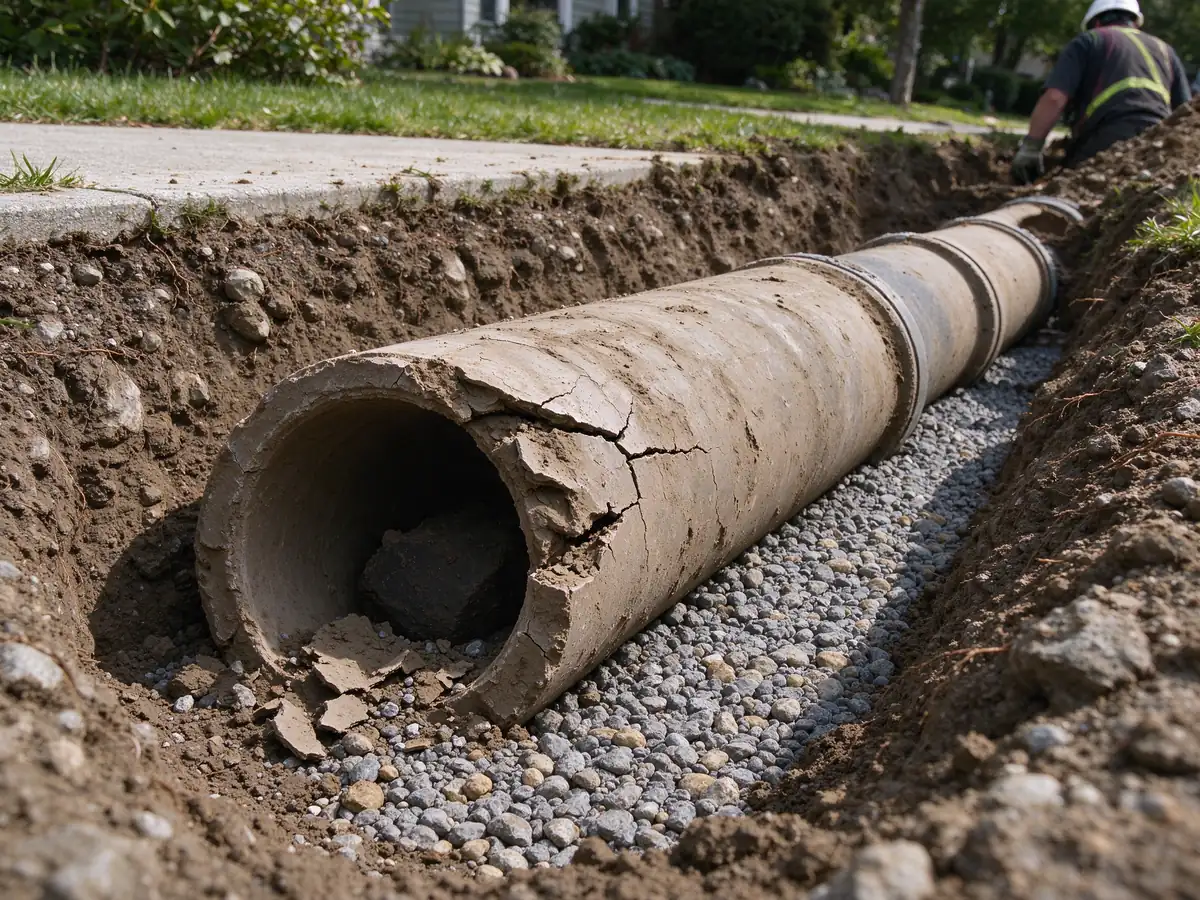
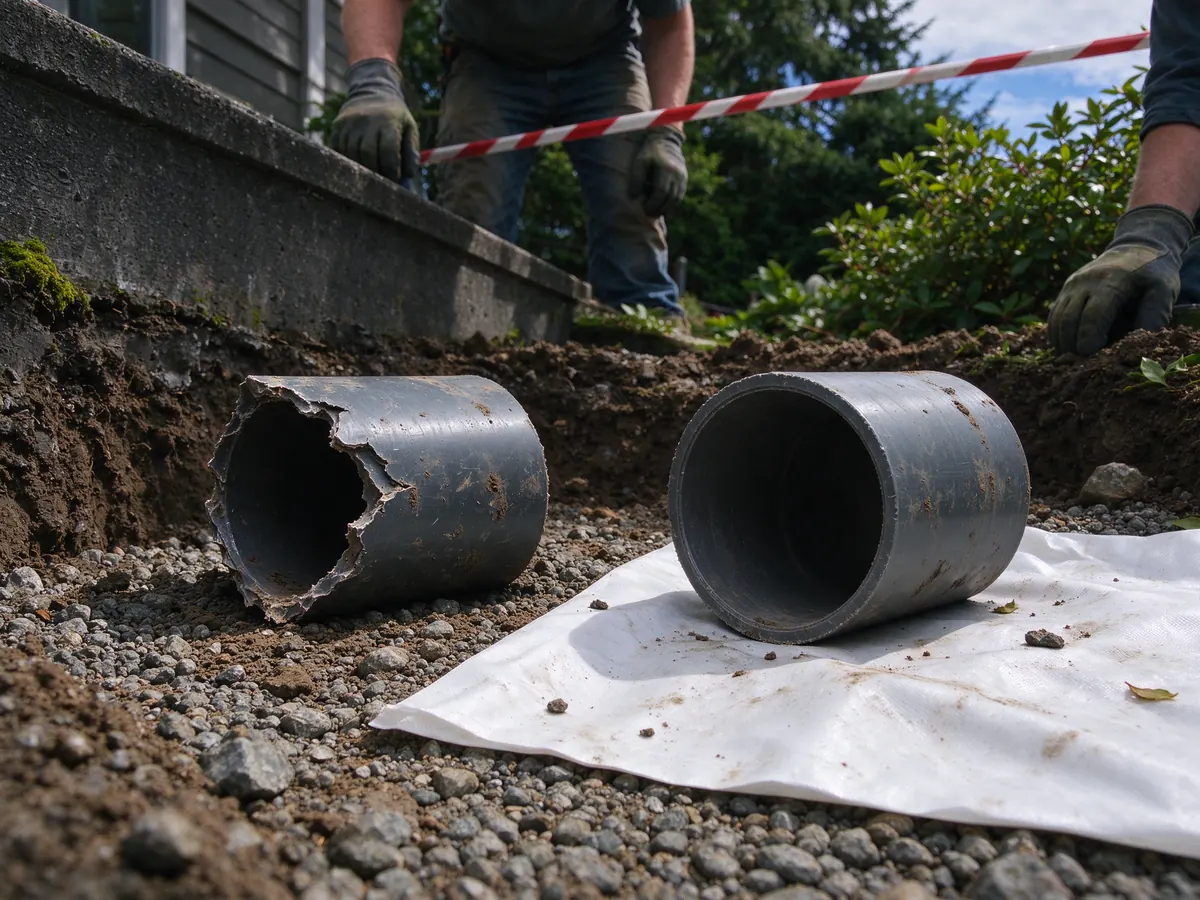
A collapsed section has lost the passage or structural shape needed for the sewer to function as intended. A rigid pipe can break and displace; a fiber pipe can deform severely; deterioration can leave material that no longer forms a useful continuous barrel. The extent of the failure matters as much as its appearance at the camera’s stopping point.
A line can also have a significant restriction without a collapse. An offset creates a ledge between sections, a root mass can occupy the opening, and a low section can hold water that obscures the view. Those findings can be serious, but they should not be renamed simply to justify a particular method.
Preserve the recording, inspection direction and the description of the limit. If another opinion is sought, provide the full recording rather than a single selected frame. A useful scope explains whether collapse is confirmed, suspected or hidden by the condition, and what further investigation can resolve the difference.
Make the location meaningful before opening the ground
Surface locating can connect the camera position or a visible defect to an approximate area above the line. Existing records can help explain historical routing and shared branches. The actual position and work boundary still need confirmation; a camera distance does not automatically equal the length of an excavation measured across the lawn.
The contractor also needs the relationship to utilities, foundations, retaining walls and surfaces. A short failed section can be difficult to reach if it sits beneath a driveway or at a building exit. Conversely, a striking camera image does not establish that every accessible yard section must be removed.
If the inspection stops at the suspected collapse, the downstream condition remains an uncertainty. Another access point or a carefully defined investigation may be needed. The proposal should distinguish the confirmed failed section from the portion being allowed for because it cannot yet be assessed, and explain how that allowance changes if new evidence appears.
Excavation and trenchless methods have different limits
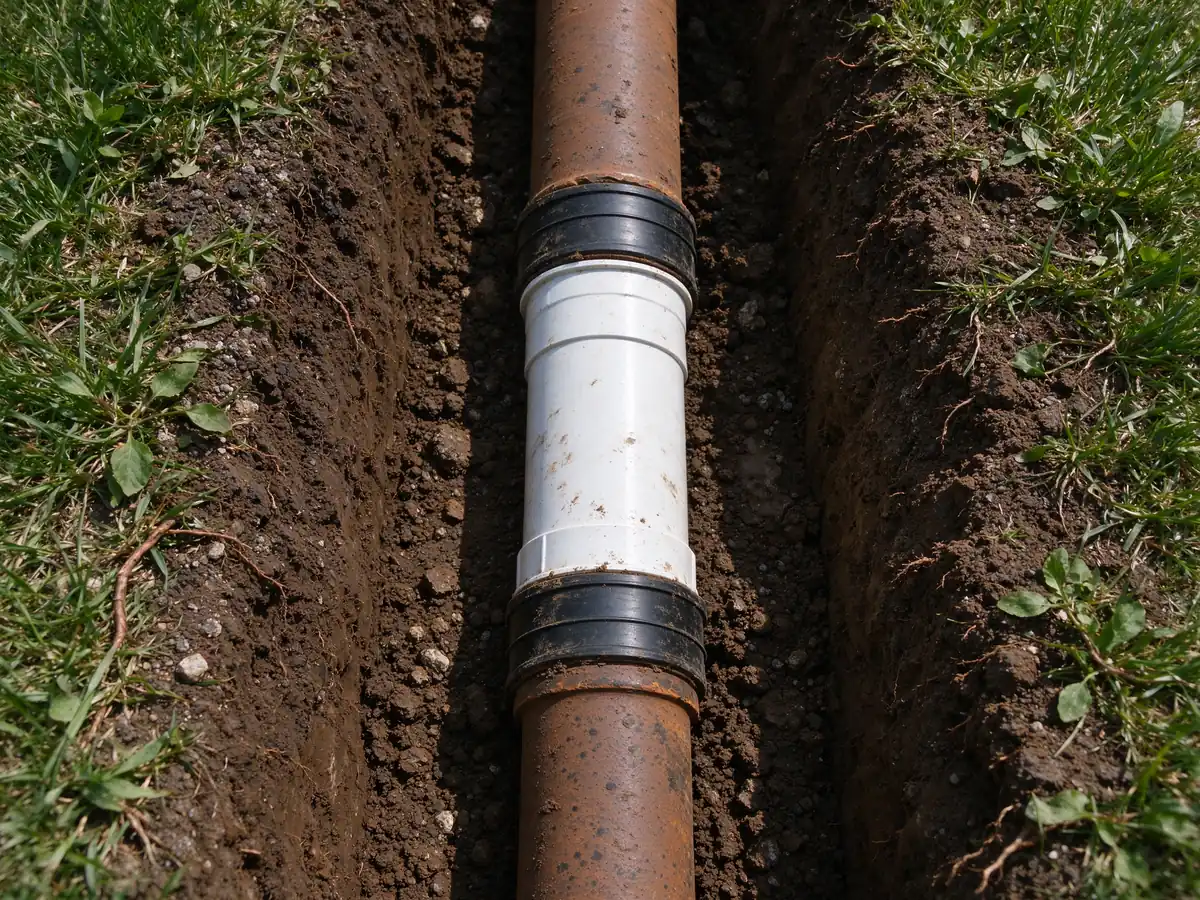
Open excavation provides direct access to remove a failed section and establish support for the new installation. It can also allow a grade or alignment problem to be addressed where that is part of the defect. Its work area includes more than the pipe diameter: access, protection, handling excavated material and restoration all need planning.
A pipe liner needs a suitable host. A missing or severely deformed passage should not be advertised as automatically lineable. Preparation, continuity, shape and the installation system matter. A proposal that simply labels every broken pipe “trenchless” has not established which method can actually be installed.
Pipe bursting replaces along an existing route where the conditions permit, but it also needs a suitable pulling and access plan. Nearby utilities, branches, bends and the collapsed area can affect feasibility. It should not be promised as a guaranteed way to correct an unknown grade problem or avoid every surface opening.
Decide how much pipe needs replacing
A localized failure with serviceable pipe around it can support a spot repair. That conclusion needs enough evidence about the retained run. A camera that stops immediately before a break may not provide it. The contractor should explain what establishes the repair endpoints and which nearby connections must be retained or renewed.
Wider replacement may be appropriate where deformation, repeated fractures or loss of condition extend beyond a short area. That is a different scope from replacing an isolated section. The word “complete” still needs physical endpoints, particularly near a building, a shared connection or the public-main interface.
| Evidence or constraint | What the proposal should resolve |
|---|---|
| Camera stops without a clear view | Confirmed finding versus inspection limit |
| One short failed section | Condition of the pipe proposed for retention |
| Loss of shape along the run | Whether sectional work leaves known failure behind |
| A low or displaced route | How the replacement changes grade or support |
| Street or shared connection | Ownership, approvals and coordinated access |
Seattle ownership and the work location
Seattle owner responsibility for a side sewer can extend beyond the lot boundary toward the public-main connection. A failure under the street is therefore not automatically a municipal-main repair. Establish the actual connection and jurisdiction before assigning the work or assuming the City’s maintenance responsibility pays for the private lateral.
Seattle Public Utilities handles the side sewer permit pathway. Work affecting the public right-of-way can also involve SDOT, and interior building-drain work has a different regulatory interface. The proposal needs to identify who coordinates the relevant approvals and inspection sequence for the defined scope.
For new sewer pipe longer than ten feet, SPU states that pressure testing is required. A post-work camera recording is useful documentation, but it is not a replacement for an applicable test or official inspection. Keep the distinction clear when a proposal lists “final camera” as its only description of completion verification.
Restoration is part of the collapse-repair decision
The access opening can affect soil, paving, planting or a slab even when the failed pipe section is short. Ask which surfaces are opened, how backfill and compaction are handled and where the restored finish begins and ends. A rough patch allowance should not be mistaken for replacement of an entire driveway or landscaped area.
If work reaches a footing or unstable ground, the contractor needs a suitable plan for those conditions. Homeowners should not enter a trench to investigate a suspected collapse. Equipment, protective measures and utility conflicts belong to qualified work planning rather than an improvised excavation around the camera mark.
Unexpected conditions need an authorization path. Ask how additional damage, a different material transition or an unrecorded branch will be documented and priced. That makes an investigative opening easier to distinguish from permission to extend replacement indefinitely along the route.
Use the correct budget category
Seattle-area planning context is $1,950–$8,800 for a defined spot repair where the remainder is sound, and $13,000–$41,600 for a complete lateral replacement. These are different work categories, not a special fixed price for the word “collapse.” A project can fall outside either range because of access, depth, street work or restoration.
The cost guide explains the component questions. Do not use a guessed length and a per-foot lining figure to price a collapsed host before suitability has been established. Compare the work endpoints, selected method, retained connections, approvals and restoration before comparing the totals.
For insurance, preserve the findings and ask the carrier about the actual policy and cause before relying on coverage. A backup cleanup claim and replacement of damaged pipe may be treated differently. Seattle’s assistance pathway also has eligibility and application timing requirements; its existence is not a guarantee that an independently arranged repair qualifies.
Describe active symptoms without exposing anyone to the line
If wastewater is entering the building, reduce use and keep people away from the affected area while qualified assistance is arranged. Report a suspected public-system problem to the serving utility as well. Do not remove a pressurized cleanout cap or attempt to enter a sewer structure to confirm a collapse.
Get an Estimate for collapsed sewer line repair with the address, complete recording, known access and any existing proposal. The most useful starting question is what must be established before the failed section can be repaired, rather than which replacement method sounds least disruptive.
What the scope should include
- Camera distance and sonde location of the collapse
- Named method and stated repair length
- Trench protection and excavation plan
- Side sewer and right-of-way permits that apply
- Bedding, backfill and named surface restoration
- Camera inspection of the line after repair
How collapsed sewer line repair compares with the alternatives
| Option | What it changes | What it leaves | Fits when |
|---|---|---|---|
| Excavated section repair | Removes the collapsed length and installs new pipe on prepared bedding | Defects outside the excavated section | The collapse is located and the rest of the run is sound |
| Pipe bursting | Pulls new pipe along the old route, breaking the remaining pipe outward | The route's original grade, including any sag | A path can be opened for the bursting head and grade is acceptable |
| CIPP lining | Not a fix for a full collapse; a liner needs an open host pipe | The blockage a liner cannot pass or round out | Only after a dug repair reopens the collapsed point |
| Full line replacement | New pipe on a corrected route and slope | The public main unless the scope includes it | There are several failures, lost grade or an unusable old route |
How collapsed sewer line repair moves from inspection to record
- Locate the collapseMeasure the camera distance and mark the spot and depth with a sonde from the surface.
- Assess the accessMap utilities, hardscape, trees and whether the collapse sits in the yard or right-of-way.
- Choose the methodSelect section repair, bursting or replacement by what the pipe beyond the collapse shows.
- Permit, protect and digObtain permits, protect the trench and replace the failed pipe on proper bedding.
- Inspect and restoreCamera the full line, then backfill and restore the surfaces named in the scope.
What this work looks like
Questions about this work
Does a camera stopping in the sewer prove the pipe has collapsed?
No. Roots, deposits, an offset or another restriction can also stop equipment. The report should distinguish a visible collapse from an inspection limit and identify what evidence would resolve the uncertainty.
Can a collapsed host always receive a CIPP liner?
No. Lining requires a suitable host and installation route. Loss of continuity or severe deformation can change the feasible methods and may require direct access or replacement.
Why does a collapse proposal need downstream inspection limits?
If the failed section blocks the camera, the pipe beyond it may remain unknown. The repair plan should not claim that the unseen remainder is either sound or failed without further evidence.
Can one collapsed section be replaced without renewing the whole lateral?
A localized repair may be appropriate if the surrounding pipe is serviceable and suitable endpoints can be established. Multiple failures or widespread deformation present a different scope.
Will pipe bursting necessarily remove a collapsed sewer belly?
No. Bursting generally follows the existing route and is not a guaranteed grade correction. A low section needs a plan explaining how its elevation and support will be changed.
What should a collapse-repair surface allowance cover?
Identify the access opening, backfill, compaction, affected paving or landscape and expected finish. The written boundaries matter more than an undefined promise to put everything back.
Can collapse repair extend into the public main under a private estimate?
The private work boundary and utility authorization need to be established. This service concerns private laterals; it is not an unrestricted offer to replace municipal sewer mains.
What documents should remain after a collapsed section is repaired?
Keep the original findings, final work endpoints, applicable test and permit closeout information, and available verification footage. Identify retained pipe that remains outside the completed scope.