
Last Updated:
What happens on the first visit
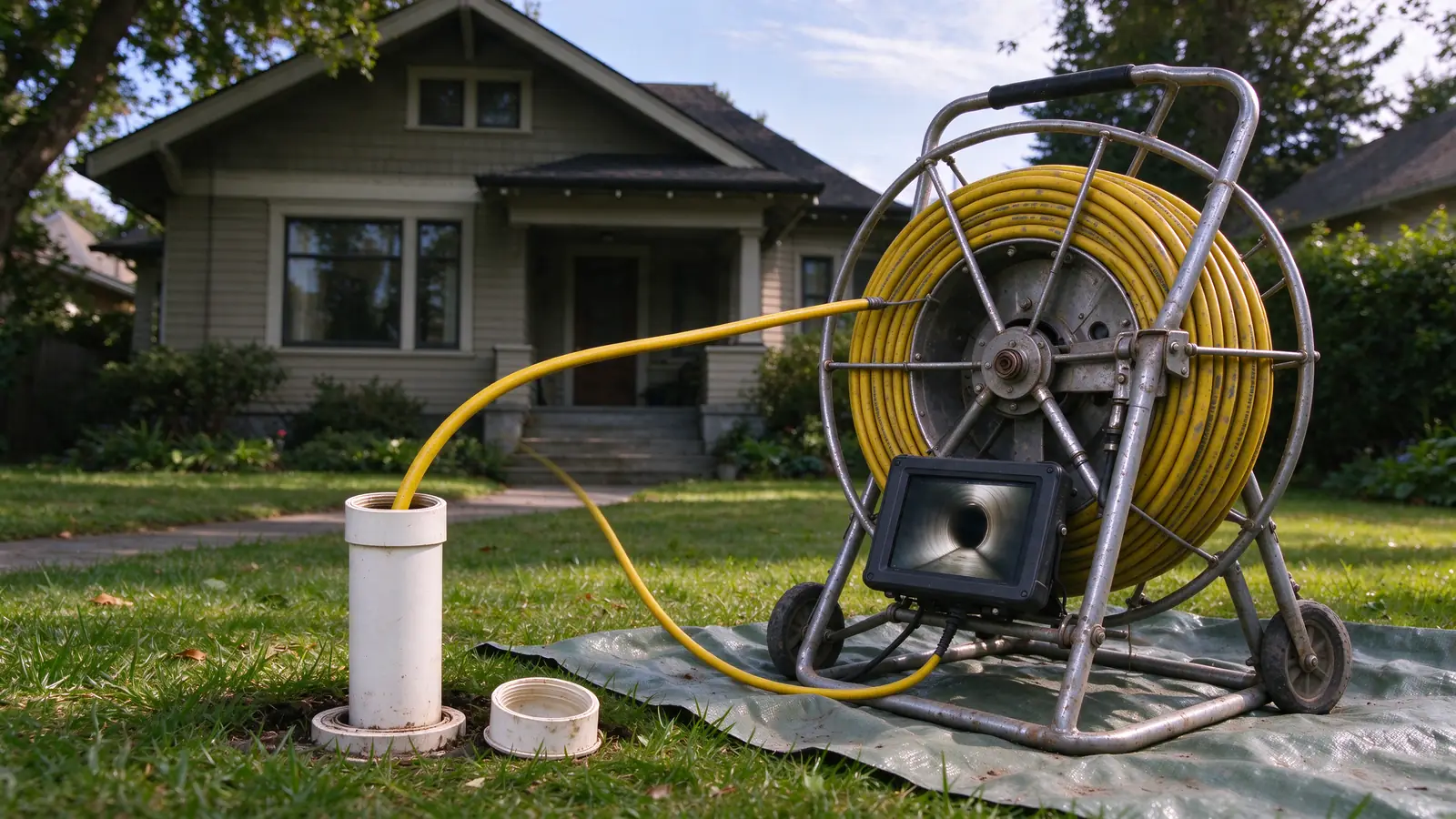
- What the camera recordsA camera goes in through a cleanout or other suitable access and travels toward the public connection, recording material, joints, roots, offsets, sags, cracks and transitions by distance. A sonde can mark key points and approximate depth from the surface.
- What to have readyKnow where the cleanout is, if there is one, and clear access to it. Note recent backups, slow fixtures and past clearing, and have any earlier video or sewer card. Running water during the visit may be requested to show flow.
- What the inspection cannot showThe camera cannot see through a full blockage or under standing water, and it shows surfaces rather than wall thickness. Where it stops, the report says so. An inspection describes condition; it does not by itself decide a repair method.
- What you receiveYou receive the video and a written summary of findings by distance, where the camera stopped and why, and what was not inspected. If repair is recommended, it is described as a separate scope rather than folded into the inspection.
A sewer camera inspection in Seattle is most useful when it produces a clear recording, identifies the inspected route and explains what the camera could not establish. A picture of roots or standing water is a finding to interpret. It is not, by itself, a complete replacement specification or proof that every connected drain has failed.
Douglas Sewer Line Repair Seattle provides private side sewer inspection and repair planning for homes, shared connections and commercial properties. Work is performed by fully licensed and insured contractors. The inspection should help answer the customer’s actual question, whether that is another backup, a purchase decision or disagreement between two repair proposals.
Start with the question the inspection needs to answer
Different situations call for different attention. A recurring blockage raises questions about the entry defect or condition left after clearing. A home-sale scope needs a useful record of the accessible lateral and its limits. A replacement proposal needs findings tied to the proposed work endpoints, rather than a collection of alarming still images.
Describe the affected fixtures, when symptoms occur and what changed after any recent cleaning. Multiple fixtures backing up together can point toward a downstream issue, while one isolated fixture may involve a smaller branch. These patterns help organize the inspection; they do not diagnose concealed pipe condition before equipment reaches it. If the property uses a pumped arrangement or onsite disposal, identify that before assuming an ordinary gravity lateral scope.
The access point determines what the recording covers
A camera normally enters through an available cleanout or another suitable access selected for the work. Its starting position and direction should be identified in the report. A recording beginning beside the building is not directly interchangeable with one beginning farther along the route. They may show different sections even when both are described as the property’s sewer inspection.
Access can also restrict the assessment. An inaccessible cleanout, difficult bend or obstruction may limit the reachable run. Ask whether creating access or cleaning is included, and what the plan is if the camera cannot reach the intended endpoint. The limit should remain part of the result, not disappear when a repair recommendation is summarized.
Visibility matters as much as camera travel
A camera can pass through a line while water or deposits still hide much of the wall. Root masses can obscure the joint where they enter. A recorded image with poor visibility should not be treated as equivalent to a clear view after appropriate preparation. The report should distinguish what was visible from an interpretation that needs confirmation.
Cleaning may be recommended to improve the assessment, but the method needs to suit the known material and condition. A deteriorated pipe is not a reason to force equipment through indiscriminately. Preserve the initial findings when preparation changes what can be seen. Two contractors may reach different conclusions because they inspected at different stages, rather than because one recording establishes every answer.
What common findings actually tell you
Roots show an entry path into the sewer, often associated with a defective joint or opening. Clearing can restore passage without sealing that entry. A visible crack or offset needs its severity and extent established. Material changes can identify an earlier repair or transition, although the image alone does not establish when it was installed or how well it is supported outside the pipe.
Standing water needs context. It can limit visibility and may point toward a low section, but one screen image does not measure the full depth or length of a belly. Corrosion and deposits can also be difficult to separate without adequate preparation. The useful conclusion connects each visible condition to its location, explains why it matters and states what remains unknown before work is chosen.
| Inspection result | Useful follow-up | What it does not establish alone |
|---|---|---|
| Roots at a joint | Identify the opening and remaining pipe condition | That cutting roots permanently repairs the joint |
| Camera stops at an obstruction | State the inspection limit and next investigation | That all pipe beyond the stop has collapsed |
| Standing water | Interpret route, visibility and possible grade issue | A complete measurement of the pipe profile |
| Material transition | Locate and inspect the connection | A verified installation date or warranty |
| Clear visible replacement section | Keep the recording and endpoints | The condition of every retained branch |
Footage distance is not a dig location
The counter tracks travel along the camera’s route from its access. It is not automatically the horizontal distance from the wall, a parcel boundary measurement or an excavation depth. Bends and the position of the access can change how that distance relates to the ground above it. A repair should not be located solely by measuring the same number across the lawn.
Surface locating can help connect a camera position to an approximate ground location and depth. Historical sewer cards provide another source of route information. Keep those records together, especially when the pipe appears to cross a property line or connect to a shared run. Each source answers a different question, and none should silently substitute for the others.
A report should support a repair decision without forcing one
A suitable spot repair needs evidence that the defect is localized and the remainder is serviceable. A lining proposal needs enough information about host shape, access and connections. A grade problem needs a method that changes the affected profile rather than merely renewing the wall. The recording should support that reasoning instead of being presented as a sales formality.
Ask for the complete accessible recording rather than selected images alone. It should be understandable where the camera started, which direction it traveled and why it stopped. A short written finding can then distinguish observed condition from recommended investigation or repair. The camera-report guide provides questions for comparing an existing report with the scope being proposed.
Inspection costs depend on access and preparation
An accessible standalone camera inspection has a Seattle-area budgeting range of $250–$500 per visit. It is a planning span, not a Douglas rate or a promise that cleaning, difficult access and additional locating are included. Ask what recording and findings are supplied and whether another visit may be needed if access or visibility prevents completion.
If the inspection is part of a larger proposal, determine whether its cost is included or separately charged before adding the published range to the project budget. A limited initial inspection and a complete cleaned-line assessment are not identical purchases. The inspection cost guide explains how those differences affect a useful comparison.
Ownership and safety still set the limits
Seattle private side sewer responsibility can continue beyond the property boundary toward the public-main connection. An inspection finding near the street should be checked against utility information rather than assigned to the City from its location alone. A shared line also requires the branches and common section to be understood before authorizing work. The inspection does not settle easement rights or divide a shared bill.
If sewage is entering occupied space, reduce wastewater use and keep people away from contamination. Leave opening pressurized access points, entering excavations and equipment operation to qualified people. Report a suspected public-system problem to the serving utility. A camera visit is an investigation of the accessible private system, not a certification that the entire property is safe or that an insurer must accept the findings.
Get an Estimate for sewer camera inspection with the location, symptoms and any existing records. The best next step may be a clearer inspection, a localized repair or a broader plan. The conclusion should follow what the inspection actually establishes.
What the scope should include
- Camera run from accessible cleanout or access point
- Findings logged by distance along the line
- Sonde locating of key points where useful
- Video file and written summary
- Stated limits of what was not inspected
- Separate description of any recommended repair
How sewer camera inspection compares with the alternatives
| Option | What it changes | What it leaves | Fits when |
|---|---|---|---|
| Camera inspection | Shows material, defects, distances and approximate depth | Pipe hidden behind heavy debris or standing water | Before buying, repairing or choosing a method |
| Clean, then camera | Clears the view so defects can be read | The repair itself | Roots, grease or water obscured the first pass |
| Clearing without a camera | Restores flow for now | The cause of the stoppage unknown | An urgent blockage; a camera inspection should follow |
| Sonde locating | Marks route and depth on the surface | Condition detail, unless paired with a camera | Planning excavation or confirming a route under hardscape |
How sewer camera inspection moves from inspection to record
- Find accessLocate a usable cleanout or access point and protect the work area.
- Run the cameraRecord the line from access toward the public connection with distance readings.
- Locate key pointsUse a sonde to mark significant defects and depth where useful.
- Review the videoIdentify material, defects and any sections that could not be seen.
- Report in writingHand over video and findings, with any repair described separately.
What this work looks like
Questions about this work
What does a sewer inspection camera’s distance counter measure?
It tracks travel through the pipe from the inspection access. It does not independently establish depth, a parcel boundary or the horizontal position of an excavation. Keep the access and direction identified with the recording.
Can a camera pass be incomplete even when the cable travels a long way?
Yes. Water, roots or deposits can obscure the wall, and travel does not prove adequate visibility. The result should identify which sections were meaningfully assessed and where the evidence remains limited.
Does a camera that stops prove the downstream sewer has collapsed?
No. It establishes an inspection limit at an obstruction or access constraint. Suitable cleaning, another access or further investigation may be needed to establish what lies beyond it.
Should a buyer request the full sewer recording or only still images?
The complete accessible recording provides route context and inspection limits that selected stills may omit. Ask for the starting access, direction, meaningful distances and an explanation of the findings relevant to the purchase decision.
Can standing water on sewer footage establish the exact belly dimensions?
Not by itself. Direction, flow conditions and visibility affect interpretation. The finding should support further assessment of the profile rather than be presented as a complete measurement from a single image.
Is cleaning automatically included in an accessible camera-inspection range?
No. The regional standalone inspection band is budgeting context. Cleaning, difficult access, additional locating and a return visit can be separate. Confirm the included work and the recording supplied before comparing prices.
Does a clear lateral recording certify every interior drain?
No. The inspection covers the route and access it reaches. Uninspected branches, interior drainage and other systems remain outside that evidence unless separately assessed.
Can inspection footage decide whether an insurer must pay?
It can help document visible condition, but coverage depends on the policy, cause and insurer’s review. Ask the carrier what information and authorization it needs rather than treat the recording as a coverage decision.