
Last Updated:
A sewer defect near the street needs a different first question in Shoreline: is it in the private side sewer or the public stub? Paying for excavation before that boundary is established can send the project down the wrong path.
Douglas Sewer Line Repair Seattle provides sewer line repair and replacement in Shoreline, with work performed by fully licensed and insured contractors. We help organize the inspection findings and the private repair scope. Utility-owned facilities need to be referred to the responsible utility rather than folded into a private-yard estimate.
Confirm the ownership boundary before choosing the work
Shoreline’s wastewater code distinguishes a private side sewer from a public side sewer stub. The stub generally runs between the public main and the property line or the edge of a perpetual easement. Records and agreements can change the responsibility for a particular facility, so the location of the defect must be checked against the utility’s information.
This differs from applying Seattle’s ownership description to every nearby address. If a camera finding appears to sit beyond the private section, contact the serving utility before authorizing excavation. The City’s wastewater code explains the distinction and the qualifications that go with it.
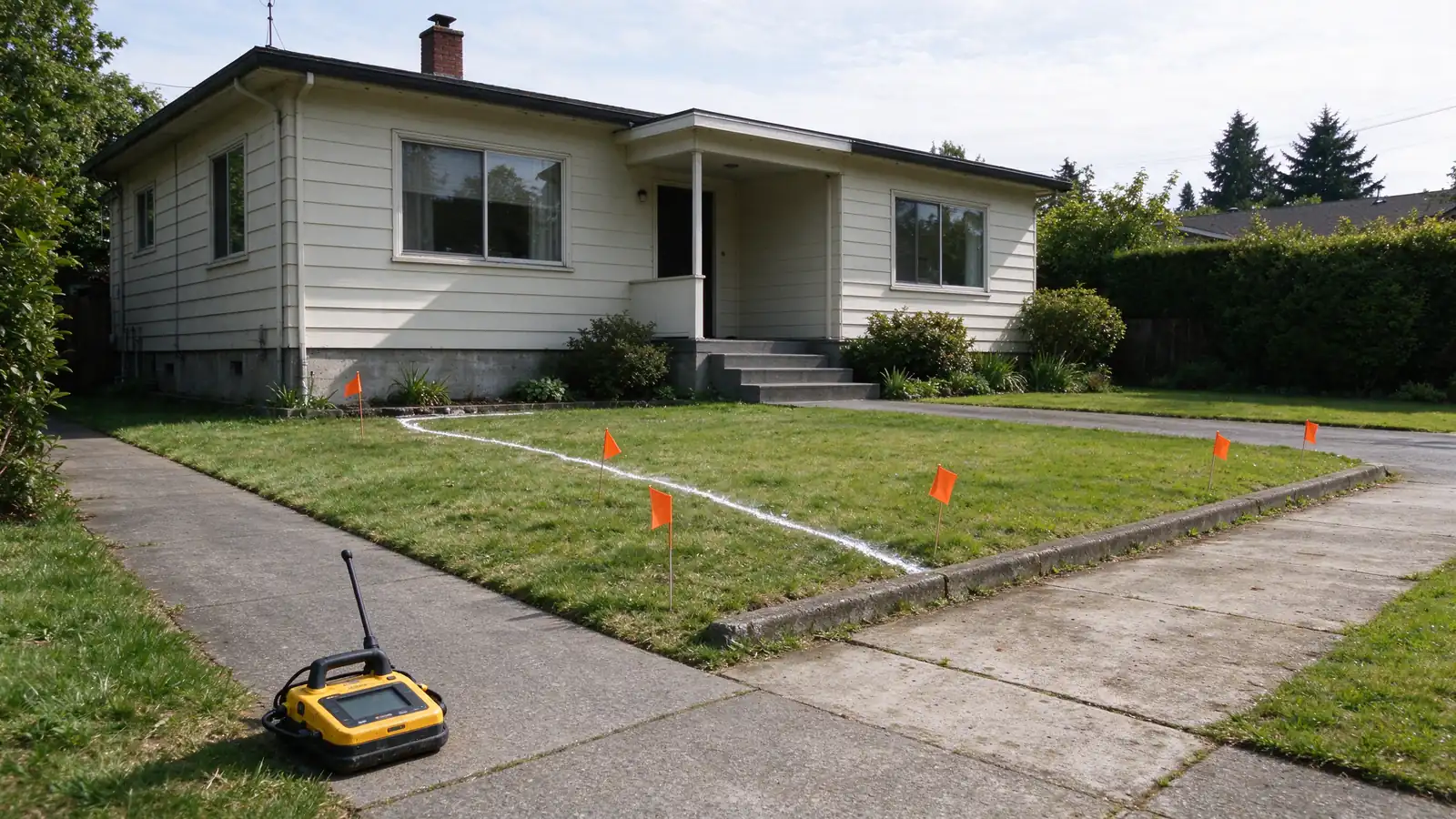
A recording’s footage counter is not a property-line measurement. It counts travel along the pipe from the inspection access. Bends, access location and the route of the lateral can separate that distance from a point measured across the lawn. Surface locating and utility records help connect the two.
A recurring blockage needs more than another clearing decision
A line that drains after cleaning may still have an open joint, offset or low section that catches material. Root removal can restore the passage without sealing the entry point. The important follow-up is whether the remaining pipe is sound enough for maintenance or whether a repair would address the recurring defect.
For a home purchase, the question is often whether an inspection finding supports a short repair or a larger allowance. A complete recording and a defined inspection limit are more useful than a single alarming still image. Our guide to camera reports explains which details make a finding actionable.
If sewage is actively entering the building, reduce wastewater use and keep people away from the affected area. Do not enter a trench or open a pressurized cleanout to investigate. Report a suspected public-system issue to the serving utility while arranging qualified help for the private line. An active backup does not establish who owns the failed section.
Match the repair to the private pipe’s condition
A spot repair can make sense where one location has failed and the remaining run is serviceable. The inspection must show enough of the rest of the pipe to support that conclusion. A short visible defect at the edge of a blocked recording is not the same as a verified isolated failure.
Pipe lining needs a suitable host pipe and preparation. It follows the existing alignment, so it does not lift a sagging section. Pipe bursting replaces along the old route where access and clearances permit. Both can reduce continuous excavation, but neither should be sold solely because a yard or driveway would be inconvenient to open.
Excavation remains relevant when the work needs direct access or a change in grade. For widespread damage, line replacement should define the complete route and the connections that must remain in service. The method comes after the defect, not before it.
Plan around the actual Shoreline property
Richmond Beach, Parkwood and Ridgecrest are useful starting points for describing a location, but a neighborhood name does not identify a pipe material or depth. A replacement sewer may follow a different route from the original installation. A house’s age is not proof that an Orangeburg, clay or concrete lateral remains in place.
Access should be checked from the street to the work area. A front-yard excavation, a rear connection reached through a narrow side passage and a line beneath an occupied building are different scopes. Retaining walls, fencing, mature vegetation and paved surfaces need to be described individually. Do not assume an excavator can reach the pipe simply because it appears close to the house on a map.
For properties near Aurora Avenue N, the Interurban Trail corridor or a shared access route, identify whether staging or excavation affects someone else’s land or the public right-of-way. Proximity alone does not establish a permit requirement. The exact work footprint and the applicable authority determine the approvals and restoration obligations.
A repair sequence with the boundary built in
The first discussion should establish what is happening, the property address and any existing inspection. Before private work is scoped, the serving utility and the location of the private/public interface need checking. An inspection and surface locate can then help define the affected portion and the limits of the evidence.
The contractor’s written proposal should identify the repair endpoints, suitable method, approval responsibilities and expected surface disturbance. Shoreline requires a permit before covered side sewer work, and the applicable inspection and record-drawing requirements belong in the plan. Confirm the requirements for the actual address and activity with the City.
Before work begins, agree on access, sewer-use interruptions and the restoration scope. Keep the available completion records with the original findings. If the work reaches the public stub or reveals a different condition at the boundary, the next step is utility coordination and a documented scope decision.
What to budget without inventing a Shoreline price band
Budget by the work scope rather than the city name. Seattle/Puget Sound planning ranges provide context: an accessible standalone camera inspection is $250–$500, and a localized spot repair is $1,950–$8,800. These are regional budgeting spans, not city averages or Douglas rates.
The larger replacement question needs a property-specific scope. Ask whether the price includes cleaning needed for inspection, locating, permits, access excavation, hauling, backfill and restoration. A proposal that assumes private ownership of the public stub can also misstate which work belongs in your estimate.
The Seattle private-property permit figure should not be substituted for Shoreline’s fees. Ask for the actual permit and inspection charges for the address and work type. Likewise, Seattle’s income-qualified side sewer assistance should not be presented as a Shoreline benefit. Confirm any local assistance directly with its administrator.
Shared lines, rental property and commercial occupancy
A shared connection can add access and coordination questions before it adds excavation. Establish which buildings join the run, where the connections sit and what recorded rights apply. An inspection can describe the pipe; it does not settle an ownership dispute or decide the neighbors’ respective obligations.
For rental and commercial properties, identify who can authorize work and how occupants will be notified about sewer-use restrictions. The repair method still depends on the underground condition, but occupancy can change the sequence and the practical cost of interruption. Include that information when requesting an estimate rather than treating it as a scheduling detail for later.
Prepare a useful estimate request
Send the property address, symptoms and any complete camera recording. Mention whether the line was cleaned, where the inspection started and where it stopped. Photographs of the access route and surfaces above the suspected defect can help explain the work area without exposing anyone to sewage or excavation hazards.
Get an Estimate for sewer work in Shoreline. If the ownership boundary is unclear, say so at the start. A clear private scope is more useful than a quick price for the wrong section of pipe.
How a Shoreline sewer job usually runs
- Inspect and locate the private side sewerA camera inspection records the access point, visible defects and where the view stopped. A surface locate and the utility's records then relate the finding to the lot, since the footage counter measures travel along the pipe, not distance to the property line.
- Check the private and public stub boundaryShoreline's code defines the public stub as running from the main to the property line or the edge of a perpetual easement, with the City utility accepting it subject to records and agreements. A defect near the street is checked with the utility before private excavation is authorized.
- Scope the private repair methodSpot repair, lining, bursting or excavation is matched to the condition documented in the private section only. Lining follows the existing profile and does not lift a sag, so a low section that needs regrading points toward excavation rather than a trenchless method.
- Obtain the Shoreline side sewer permitShoreline requires a permit before covered side sewer work. The proposal identifies who applies, the applicable inspection and record-drawing requirements, and whether staging or excavation reaches the right-of-way or a neighbor's land, which brings separate approvals and restoration.
- Inspect and keep the record drawingRequired inspections take place before the work is covered. The completion file keeps the record drawing, final scope and available verification footage with the original findings, and any condition found at the stub boundary goes back to the utility as a documented scope decision.
Why this approach fits Shoreline
Shoreline's ownership boundary sits closer to the street than a Seattle-based assumption would place it, because the City utility accepts the stub out to the property line or easement edge, subject to records and agreements. A camera finding near the street may therefore be the utility's responsibility. Inspecting and locating first places the defect on the correct side of that line before anyone prices excavation, and lets the method fit only the private section that actually failed rather than a length of pipe the owner may not be responsible for.
Shoreline service planning
Utility context: City of Shoreline, confirm for address
Permit pathway: City of Shoreline
Shoreline neighborhoods
- Richmond Beach
- Parkwood
- Ridgecrest
- North City
- Echo Lake
- Richmond Highlands
Landmarks and routes around Shoreline
Landmarks: Interurban Trail · Hamlin Park · Echo Lake Park · Kruckeberg Botanic Garden
Main routes: Aurora Avenue N · Interstate 5 · State Route 523 (N 145th Street)
Listed for orientation only. They do not indicate an office or completed jobs.
Questions about this work
Should I authorize digging if the finding is in Shoreline’s public stub?
Contact the serving utility before including that section in private excavation. The location and the ownership records need checking; a camera distance alone does not settle the boundary.
Do Seattle side sewer ownership rules apply to my Shoreline home?
Do not assume they do. Shoreline distinguishes the private side sewer from the public stub, with qualifications for records and agreements. Confirm the applicable utility and responsibility for the specific facility.
Is there a separate Shoreline repair price I should use?
Use the regional work-category ranges as planning context, then obtain a site-specific scope. An accessible standalone inspection is $250–$500 regionally. There is no reason to invent a different number solely because the address is in Shoreline.
Does being near the Interurban Trail change the sewer method?
The nearby landmark does not choose a method. Actual access, the pipe route and whether work affects public land or another property determine the planning questions.
Can a municipal pipe-renewal project replace my private lateral?
A City project has its own defined limits. Check the published project scope and contact the utility. Do not assume that work in the street includes the entire private connection serving your building.
What should neighbors settle before a shared-line repair?
Identify the connected properties, the affected common section and access rights, then agree on authorization and cost arrangements. The inspection describes the pipe; it does not resolve the neighbors’ legal obligations.